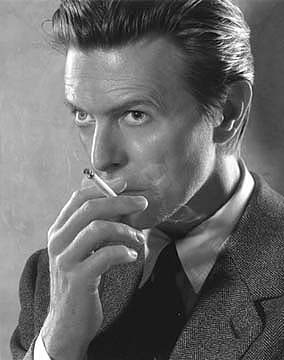
So there's simply no way to do justice to a musical icon such as David Bowie in a single post, so I'm going to concentrate on my favorite period of his music - the most recent stuff.
For me, Bowie just gets better with age. He's one of the few artists I can say that about. Most hit their peak early and spend long years trying to top their earlier success or are content to repeat past glories. While there's an awful lot I like from Bowie's earlier work (in particular the 'Berlin Triology' which I need to spend more time with) my favorite and I think most accessible music can be found on albums from Outside (1995), Earthling (1997), Heathen (2002), and Reality (2003). It's probably the fusion of rock and electronica that appeals to me most.
Let's take a closer look at each of these amazing albums:
- Outside - This album was really a comeback album for Bowie in a lot of ways. He had a string of unsuccessful albums in the late 80s and kind of dropped off the radar for a while. Outside is a concept album of sorts dealing with his own freaky vision of the world at the turn of the millennium. Bowie toured this album alongside Nine Inch Nails in one of the more potent mix of double-headliners ever. Songs to listen to are: I'm Degraned, Hallo Spaceboy, I Have Not Been to Oxford Town, Heart's Filthy Lesson, and the title track.
- Earthling - In my circle of friends, this was the one Bowie album you could count on everyone having. This is Bowie's "Jungle" album which is to say a particular style of techno. I remember rather heated arguments about whether or not this album actually counted as a techno album, or if he was really more of a copy-cat artist and didn't really "get" the style he was emulating. Doesn't matter to me, the music is fantastic and a wonderful fusion of many styles. Be sure to give a listen to Little Wonder, Battle for Britain, and Dead Man Walking.
- Heathen - A decidedly dark album in places, the opening track might be my favorite Bowie song of all time, Sunday. After the experimentation of the last two albums, Heathen was a high water mark for Bowie's latter day sound and one of his most critically acclaimed albums in a long time. Besides the haunting Sunday, also give a listen to Slip Away, Cactus, and 5:15 The Angels Have Gone.
- Reality - Continuing in the same vein as Heathen, but a bit more relaxed and prosaic, Reality is Bowie's most current album (2003) which means we're probably overdue for another! Although another solid effort, Reality doesn't quite have the impact of the previous few albums. You could almost pass up this album if not for the closing track, Bring Me the Disco King, which is close to the top of all-time favorite Bowie tracks for me. Also give a listen to the George Harrison cover, Try Some Buy Some, and the soothing Fall Dog Bombs the Moon.
Videos